Before they went tumbado, corridos were already telling the world’s stories.
From border ballads to Natanael Cano, Junior H and Peso Pluma: where the movement came from, how its sound changed and what history it carries.
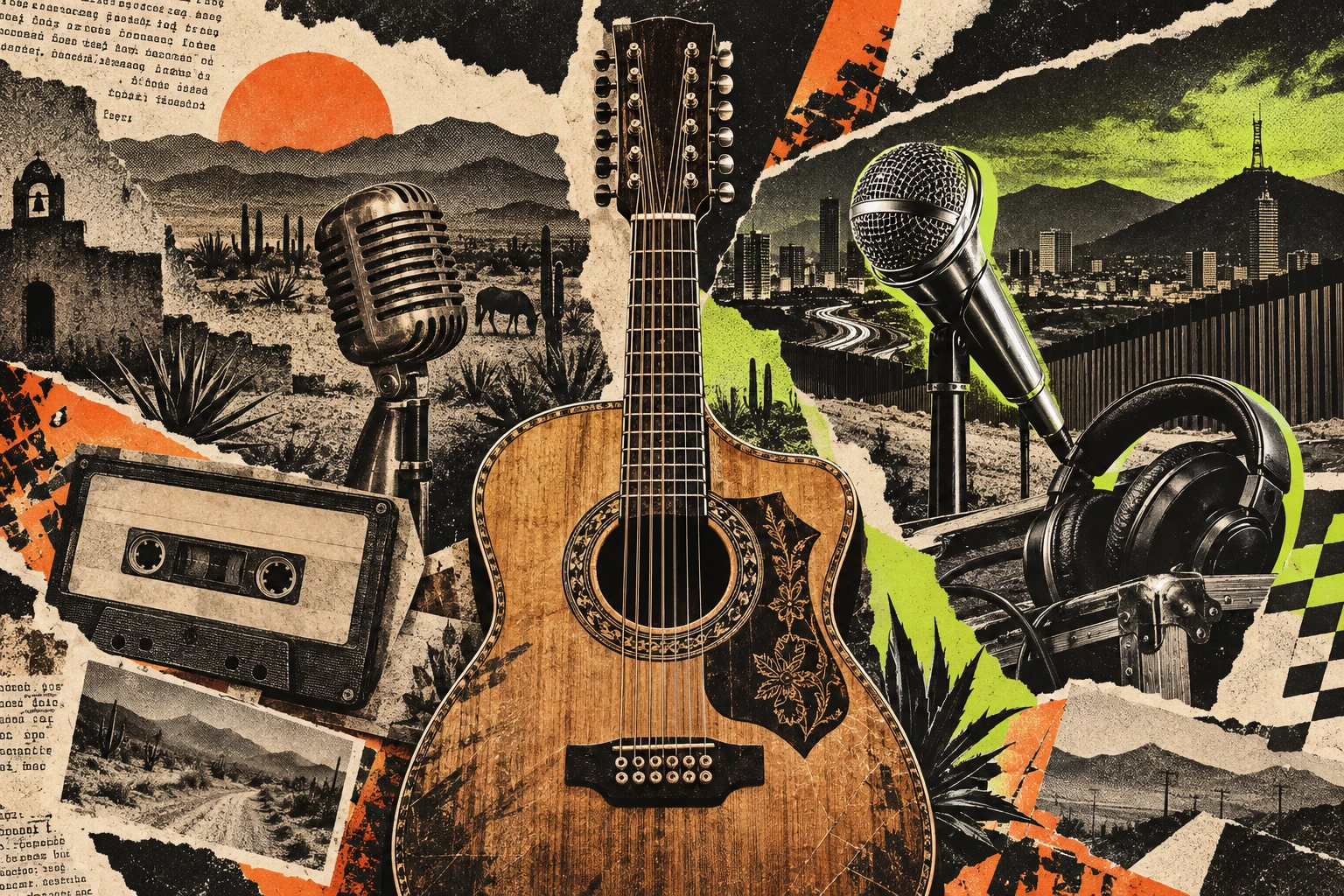
A requinto can sound like family memory and the present moment at once. That is one of the richest tensions in corridos tumbados: they make an inherited sound recognizable while asking who gets to change it. Their story is more complex than simply adding trap to a corrido. Musicians, migration, labels, playing styles and audiences all helped prepare the ground.
This is a genealogy of the movement, focusing on its predecessors and its rise from 2019 to 2024. It is not a family tree for all Mexican music. Each chapter links its factual sources. Passages marked as editorial readings offer interpretation, not statements from the artists.
01 / First: regional is not one genre
“Regional mexicano” is a broad industry category. It includes mariachi, banda, norteño, sierreño, corridos and other forms that do not share a single set of instruments or one point of origin. The Recording Academy itself groups several traditions under its Mexican music categories. Treating them as one rhythm erases differences audible from the first bars.
How a song is played and what kind of song it is are separate questions. A corrido tells a story; it does not require a single instrumental template. Mariachi has its own varied repertoire. It is not a primitive stage that had to evolve into tumbado. That is why La raíz also has a separate story about mariachi.
Our reading: a tidy ladder from mariachi to norteño to corrido to tumbado is tempting but misleading. Think of intersecting paths instead. A new voice, arrangement, way of circulating or sense of generational identity can change the music without making everything before it disappear.
02 / Stories before the Revolution
The Library of Congress places the corrido within a tradition of narrative songs and notes its Spanish antecedents. That does not give us an indisputable birth certificate. UCLA’s Frontera Collection describes the Mexican form taking shape in the 19th century, between Independence and Revolution. We should distinguish the ballad’s antecedents, the formation of the Mexican corrido and its later commercial circulation.
The 1910 Revolution gave corridos characters, battles and public force; it did not invent them. UCLA documents Rafael Herrera Robinson’s 1904 recordings of “Heraclio Bernal” and “Ignacio Parra,” concrete evidence that the repertoire circulated before the uprising. Songs about the taking of Torreón or Matamoros show another use: turning an event into a story people could remember and sing again.
Smithsonian points to a wide range of subjects, from revolutionary figures and local heroes to romance. Reducing every corrido to drug trafficking projects one part of today’s repertoire onto a much longer tradition.
Our reading: calling a corrido a “sung newspaper” is a useful start but too narrow. A song chooses characters, shapes sympathy and tries to move its listeners. It is not a substitute for reporting, nor proof that everything it describes happened as sung. The distance between memory, invention and document still matters when we listen today.
03 / Los Tigres and Chalino: story, business and closeness
In 1974, the album Contrabando y traición marked a turning point for Los Tigres del Norte. Its title song put Camelia at the center of a tale of smuggling and betrayal. AllMusic’s account of the group also shows the corrido within an industry of recordings, sales and shows: popular music is a business, too.
By the late 1980s, Chalino Sánchez was recording and selling cassettes in Los Angeles. Musicians from Los Amables del Norte told EL PAÍS about his commissioned corridos and spontaneous recording style. They also backed the sentimental “Alma enamorada.” A corrido singer’s repertoire could hold other kinds of songs.
Our reading: these are different routes to credibility. A story can persuade through its dramatic structure; a performance can persuade through a feeling of closeness. An artist need not sound polished to feel believable to an audience. That trust does not turn every character in a song into the singer’s autobiography.
A cassette passed among friends and a track shared from a phone both rely on networks of trust, though today’s platforms add metrics, automated recommendations and a different commercial scale. The enduring question is who gets heard, and through which relationships.
04 / Ariel Camacho puts the guitar up front
Apple Music dates El Karma by Ariel Camacho y Los Plebes del Rancho to September 23, 2014. Camacho is a key predecessor for understanding the ears of the next generation. EL PAÍS documented Natanael Cano’s acknowledgment of his influence. Recognizing that influence does not require calling Camacho the inventor of tumbados.
Our reading: a string led lineup changes where we listen. The voice can tell the story while a guitar answers, anticipates or closes a phrase; the low register carries the group’s weight. A small arrangement is not necessarily simple. It exposes every player’s decisions.
Listen to musical roles instead of searching for one magic instrument. Requinto names a recognizable melodic role; bass and accompaniment add depth and movement. To compare generations, ask who leads when the singer pauses. That reveals more than an abstract opposition between tradition and modernity.
05 / California is part of the roots, too
The bridges were forming before 2019 became a landmark year. In November 2018, El Nuevo Sol reported on corridos verdes in Los Angeles and the Rancho Humilde scene. Legado 7 was tied to that repertoire and cannabis culture; Sony Music describes the Orange County group as a pioneer.
In a 2020 Forbes interview, Jimmy Humilde discussed Rancho Humilde’s work with artists including Fuerza Regida, Legado 7 and Herencia de Patrones. That network matters. Tumbados did not come from one person’s sudden idea, but from a space where Mexican repertoires, hip hop references and young audiences could meet.
Our reading: the border helps explain the blend without treating it as lost authenticity. Someone can know the songs of their family and build an identity with rap, streetwear and digital life. One side does not make the other less legitimate.
The industry also shapes a genre. A label groups artists, encourages collaborations and makes a scene recognizable. Naming a movement helps listeners find it and helps companies sell it. Its musical history and the history of its branding overlap, but they are not identical.
06 / 2019: Natanael names it; the scene gives it shape
Natanael Cano’s Corridos Tumbados came out on October 31, 2019, through Rancho Humilde. Its catalog includes Junior H, Dan Sanchez and Nueva Era. The “Soy el Diablo” remix with Bad Bunny arrived shortly before. That collaboration made a link to urban music visible; the album turned “corridos tumbados” into a clear statement of identity.
Cano is central to the story without erasing collaborators or predecessors. The album’s own listing shows how shared that moment was. “Disfruto Lo Malo” with Junior H is a useful stop for hearing the scene as it emerged, beyond its later hits.
Junior H had already released Mi Vida en un Cigarro in 2019. Apple Music highlights “No He Cambiado” and the artist’s migration from Guanajuato to Utah as a teenager. His place in this story brings uncertainty and vulnerability alongside confidence and ambition.
Our reading: 2019 is a moment of consolidation, not a minute zero. The name gathered sounds already in motion and gave others room to develop. Cano became a recognizable public face; collaboration made that face part of a wider conversation.
07 / What makes it tumbado? Listen beyond the beat
The Recording Academy describes Cano’s contribution as turning the corrido toward hip hop and trap. That is useful if we do not turn it into a mechanical recipe. Influence can live in vocal attitude, language, image and collaboration. Every track need not have electronic drums.
Our reading suggests four layers to hear. Start with the voice: its pauses and closeness to speech. Then the strings: short flourishes that work like melodic signatures. Listen next to the low end and how it adds motion or weight. Finally, listen to the character speaking: whom they address, what they display and what they need to prove.
That final layer connects form and meaning. A list of brands can stage a rise in social status; a confession can interrupt a pose of invulnerability. Songs do this in different ways and with different depth. Analyze the track rather than assuming its meaning from the singer’s clothes.
Labels also need care. “Corrido” points to narrative; “sierreño” to a sound tradition; “tumbado” to a movement and its crossings; “bélico” to a combative image a song may use. These dimensions can overlap without meaning the same thing. A romantic song by a tumbado artist is not automatically a narcocorrido, and an acoustic guitar does not make a production old fashioned.
08 / 2023–2024: global reach and shared credits
In 2023, “Ella Baila Sola” by Eslabón Armado and Peso Pluma became the first regional Mexican song to reach the Billboard Hot 100 top ten, peaking at number four. BMG documented the milestone, and Associated Press reported its peak. It did not top that chart. Confusing the Hot 100 with other lists changes the meaning of the achievement.
Eslabón Armado must be named alongside Peso Pluma. BMG’s own account credits Pedro Tovar as a songwriter. A story focused only on the most visible star repeats the imbalance between writing, performing and public attention.
In 2024, Peso Pluma’s Génesis won the Grammy for Best Música Mexicana Album, including Tejano. That institutional honor and the chart reach of “Ella Baila Sola” are separate milestones. Neither means the music lacked artistic worth or an audience before those dates.
Our reading: global success brings new listeners to a repertoire; it does not create its earlier history. It also changes incentives, raising demand for collaborations and recognizable sounds. The creative challenge is to use that visibility without reducing a wide musical world to a repeated formula.
09 / Power, desire and harder questions
Our analysis holds two ideas together. A song can offer belonging, wit or release and also make power look seductive. Seeing one possibility does not require ignoring the other. Criticism loses precision when it treats every listener as complicit or every song as a court document.
In stories of rising from hardship, money may stand as proof of escape. But consumption alone does not explain how power was gained or who paid its costs. Ask of each track: does the story show consequences, or only rewards? Narrating violence, admiring it and using it as decoration are different acts.
Gender and voice deserve the same attention. Do women have stories of their own, or do they appear only as signs of someone else’s success? Does sadness allow vulnerability, or does it reinforce possession of another person? A close reading can recognize expressive strengths and limits within the same song.
We should also question how we write this history. A tour of the most visible male names is not a census of everyone making Mexican music. Treating one scene’s popularity as a map of the whole country leaves out other voices, regions and experiences. This genealogy is an entrance, not a boundary around who belongs.
To us, the discovery of tumbados is that they make the right to update an inheritance debatable. The requinto can sit beside an urban identity without asking permission. But a rebellious label should not exempt a song from critical listening. The roots stay alive because that conversation remains possible.
A timeline
- 1904: Rafael Herrera Robinson records corridos before the Revolution.
- 1974: Contrabando y traición marks a breakthrough for Los Tigres del Norte.
- LATE 1980s: Chalino begins circulating cassettes in Los Angeles.
- 2014: Ariel Camacho y Los Plebes del Rancho release El Karma.
- 2018: El Nuevo Sol documents the corridos verdes scene in Los Angeles.
- 2019: Mi Vida en un Cigarro, the “Soy el Diablo” remix and Corridos Tumbados arrive.
- 2023: “Ella Baila Sola” enters the Hot 100 top ten and reaches number four.
- 2024: Génesis wins the Mexican music Grammy.
Eight listening stops
- Heraclio Bernal · Rafael Herrera Robinson · 1904 recording
Start before the Revolution. UCLA provides the historical context and a link to the recording.
- Contrabando y traición · Los Tigres del Norte · 1974
Hear how the story builds its characters. The linked discography places the album in the group’s career.
- Alma enamorada · Chalino Sánchez with Los Amables del Norte
A sentimental counterpoint: a corridista’s career is not all corridos. The reporting includes his musicians.
- El Karma · Ariel Camacho y Los Plebes del Rancho · 2014
Listen to the guitar and voice answer each other. The catalog has the album and its tracks.
- No He Cambiado · Junior H · Mi Vida en un Cigarro, 2019
A doorway into Junior H’s early songs. Some catalogs spell the title “No Eh Cambiado.”
- Soy el Diablo (Remix) · Natanael Cano and Bad Bunny · 2019
A key crossing with urban music. The linked catalog dates the single to October 25, 2019.
- Disfruto Lo Malo · Natanael Cano and Junior H · 2019
Hear collaboration as part of the movement’s public emergence, not a footnote to a solo career.
- Ella Baila Sola · Eslabón Armado and Peso Pluma · 2023
The global milestone with both acts up front. BMG documents its chart entry.